
Get Support
07496822205
Thickness vs Price: Understanding Green MDF Costing
-
 By: Ethan
- May 12, 2026
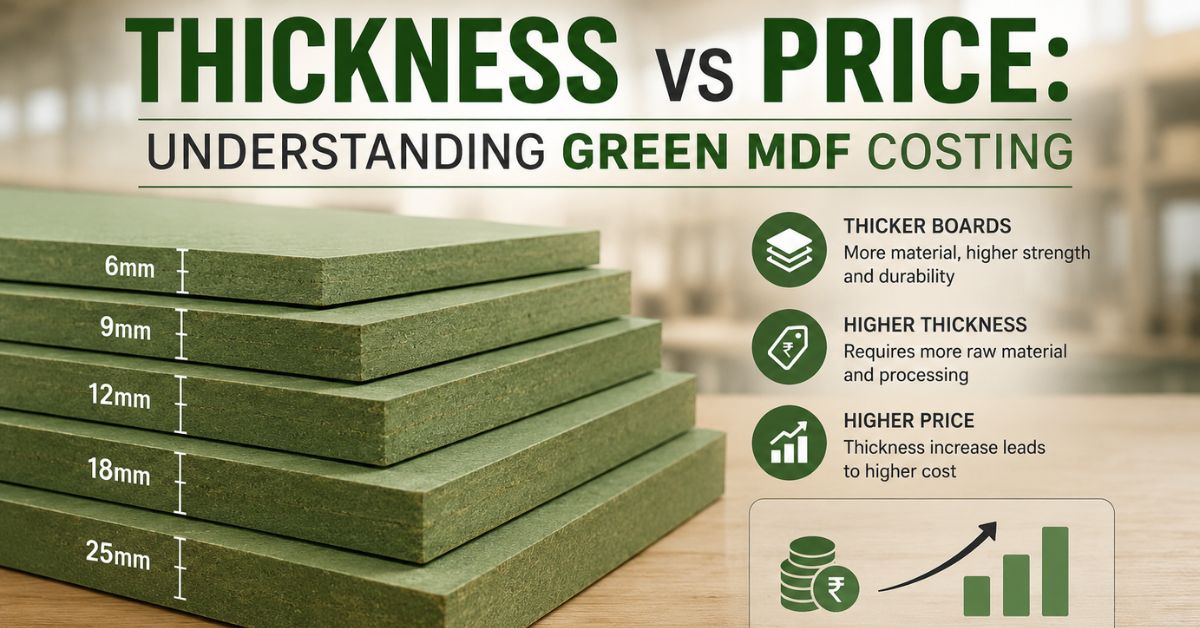
In the dynamic world of interior design and construction, Green MDF boards are increasingly used for their flat surface, strength, and moisture resistance. Understanding the cost of Green MDF Board based on thickness is essential for informed buying decisions, with the growing demand for residential and commercial applications. We aim to provide customers with detailed information on the impact of thickness on cost so they can make informed decisions and obtain value for money.
Green MDF, also known as moisture-resistant MDF, is designed to withstand moisture. Its distinctive green core, which indicates greater durability than standard MDF, makes it suitable for use in kitchens, bathrooms, and other areas with high moisture levels. But the price can differ depending on manufacturing process, density, and thickness.
Comprehending Green MDF Board Thickness
Thickness plays a crucial role in determining Green MDF boards' cost and strength. Common thickness variations with different applications include 6mm, 9mm, 12mm, 16mm, 18mm, and 25mm.
Thinner boards, such as 6mm and 9mm, are generally used for back panels, decorative elements, and light constructions. They are cost-effective and suitable for applications where heavy loads are not a concern. But due to their superior strength and durability, thicker boards such as 18mm and 25mm are commonly used for furniture, cabinet, and partition manufacturing.
The thickness increase affects the cost of Green MDF Board in terms of raw material, manufacturing time, and finishing processes.
How Thickness Affects the Cost of Green MDF Boards
Although thickness and cost have a linear connection, a number of other elements also play a role. As thickness increases, the volume of wood fibers, resin, and treatment chemicals required also increases. Higher production costs result from this, and the market price reflects this.
For instance:
6mm Green MDF Board price is relatively low, making it ideal for budget-conscious projects.
Strength and cost are balanced in the mid-range pricing category of 12mm to 16mm boards.
Because of their increased durability and load-bearing capacity, 18mm and above are more expensive.
In addition to using additional materials, thicker boards go through more stringent pressing and curing procedures to guarantee consistent density and moisture resistance. The cost is further increased by these extra manufacturing procedures.
Density and Quality: Hidden Factors Behind Pricing
Density is just as important in assessing the true worth of Green MDF boards as thickness, which is a visible metric. High-density boards provide longer lifespans, smoother finishes, and greater screw-holding ability.
Within the same thickness category, manufacturers frequently create boards with different densities. The cost of a 12mm high-density board may be higher than that of a 16mm low-density board, highlighting the significance of considering both density and thickness simultaneously.
When evaluating the cost of Green MDF Board, it is crucial to take into account:
- Consistency of core density
- Smoothness of the surface
- degree of resistance to moisture
- Quality of adhesive
ogether, these elements affect performance and support pricing differences.
Application-Based Pricing Strategy
Budgeting decisions are directly impacted by the varying thicknesses required for different applications. Choosing the right thickness guarantees peak performance while keeping expenses under control.
Manufacturing of Furniture
Green MDF boards between 16 and 18 mm are frequently used for cabinets, wardrobes, and modular furniture. These offer the durability needed for extended use, and their cost is commensurate with their structural dependability.
Wall Paneling and Accent Pieces
6mm to 12mm boards are adequate for paneling and design elements. These are affordable and simple to manage, resulting in minimal project expenses overall.
Installations in Kitchens and Bathrooms
Thicker boards, such as 18mm or 25mm, are favored in moisture-prone areas because of their improved resistance. The longevity and performance of the Green MDF Board make the investment worthwhile, despite its higher price in this category.
The Impact of Manufacturing Technology on Cost
The cost of Green MDF boards is largely influenced by advanced manufacturing processes. Modern continuous press technology produces boards with improved durability, less warping, and higher homogeneity.
Furthermore, sustainable sourcing and reduced formaldehyde emissions are examples of eco-friendly production techniques that can raise costs but greatly improve indoor air quality and environmental compliance.
Manufacturers may charge different prices for Green MDF Board based on:
- Utilized technology
- Standards for quality control
- Compliance and certifications
- reputation of a brand
Purchasing high-quality boards guarantees improved finish, reduced maintenance, and long-term financial benefits.
Price Variations and Regional Market Trends
Regional variables, including raw material availability, shipping expenses, and local demand, also affect the cost of Green MDF boards. Prices are frequently somewhat higher in urban areas where there is a greater need for modular furniture and high-end interior design.
Costs can be decreased by buying in bulk and procuring directly from manufacturers. But it's important to be sure that reduced prices don't mean lower quality.
Buyers can make strategic judgments by being aware of market trends, particularly when working on large-scale projects.
Comparing Alternative Materials with Green MDF
It is helpful to compare the cost of Green MDF Board with that of other materials like plywood, particle board, and HDF.
Plywood gives greater strength but is typically more costly.
Although particle board is less expensive, it is not as durable or moisture-resistant.
Although HDF is more expensive, it is stronger and denser.
Green MDF is a cost-effective option for the majority of applications because it perfectly balances affordability, durability, and moisture resistance.
Conclusion: Choosing the Best Green MDF Investment
It's easy to understand the price-to-thickness ratio of Green MDF boards. While thicker boards are more costly, they offer superior performance, durability, and strength. By carefully considering the project requirements and factors that impact the price of Green MDF Board, you can make informed decisions that will help you get the best value for money.
We believe the best choice should be the one that meets your needs, not the cheapest. Making informed decisions will ensure satisfaction, durability, and beauty.
Elevate your projects with top-quality Green MDF solutions, made for durability and performance. Choose Crosta Panels for quality and reliability.